Uncommon Ground.
an ice breaker game

We’ve all played some silly ice-breaker games at work or school. A few years ago, I played a decent one, but halfway through I realised that there was a better way to do it. With Claude, I implemented it and we ran it as part of the SEARCHER consortium event last week.
You can run it at https://uncommon-ground.xyz/
The rules of the game
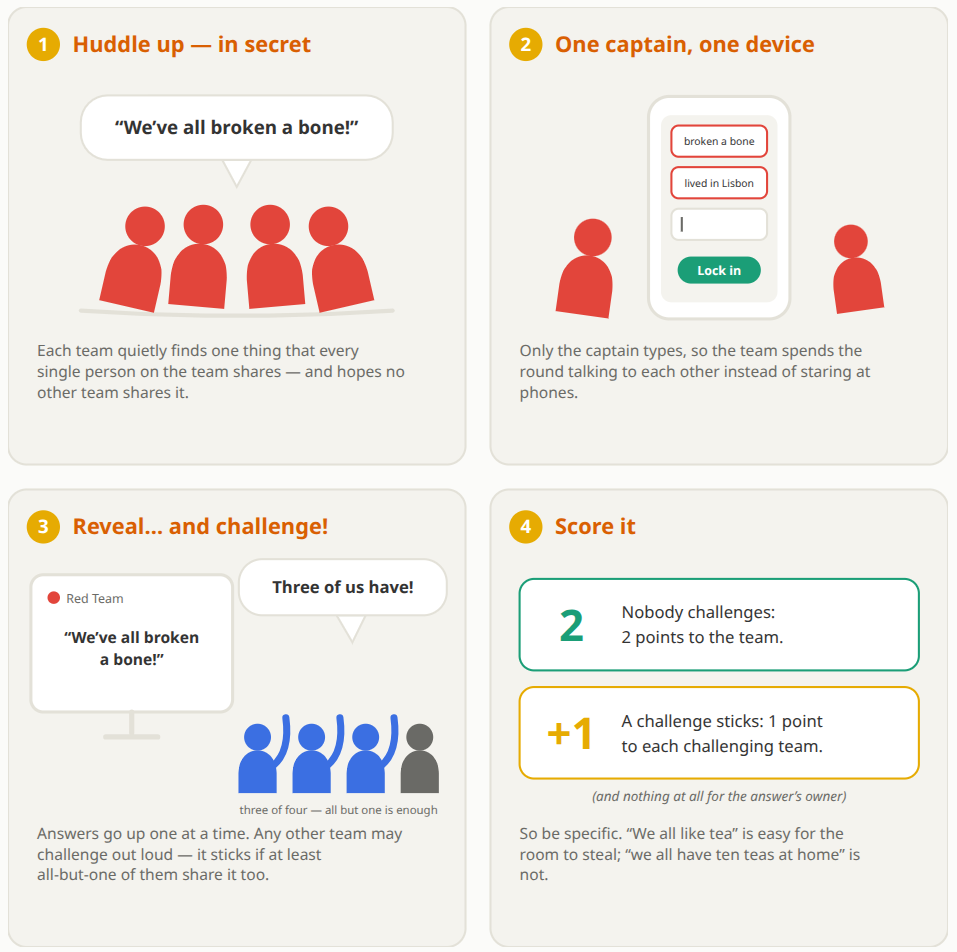
This is played by teams (4–6 people each is a good number, 3-6 teams is another good number). There are two phases.
In the first phase, reach team writes down things that everyone on the team has in common. This first is what I had played before, which was kind of fun, but the second half of the game was a bit of a letdown: the teams then read their answers aloud, and the other teams just nodded along.
Therefore, I added the second phase: the answers are revealed one at a time, and the other teams get to challenge them. The rule is that to write down a commonality, every member of the team must share it, but to challenge it, it is enough for all but one of the challenging team to have it.
You get 2 points if your answer is unchallenged, and 1 point for every successful challenge. The team with the most points at the end wins. The challenge mechanism means that while writing something basic like we all had coffee today is a legal move, it is a bad move.
You can run it yourself, if you’d like: https://uncommon-ground.xyz. You need a projector/big screen and an MC to run it and every team needs someone with a phone to join the game (just one).
A few design choices
Only the captain’s phone is in the game. Each team designates one captain, and only the captain’s phone is in the game. In fact, if a second person joins the team, that triggers the first person to be kicked out.1 This is intended to keep the game social and have people look at each other instead of their phones.
We need a human MC. When an answer is revealed, challenges are shouted out and adjudicated by the MC. This was again, about trying to make the game more IRL.
Multiple teams can score challenge points for the same answer. I did not want to make this a first to buzz game. Let people talk it out. Even if another team has already challenged an answer, you can still challenge it as well, so you are incentivised to keep thinking and discussing with your team.
Answers are shown one by one. Showing the answers is also part of the game, so they are revealed one at a time. This probably slows down the game a bit, but you do want to give time for everyone to process information like we all lived in Helsinki at some point and think about whether they can challenge it.

This was obviously vibe coded
This was almost completely vibe coded with Claude. I wrote the rules in bullet points and Claude designed the app. I iterated a few times, but I hardly looked at the code. I asked it for deployment instructions and it gave me a few things to copy & paste into my AWS server and that was it. Almost all my decisions were design decisions.
The biggest category of mistake it consistently made was that it was consistently fragile if users have flaky internet connections. This is hard to encode as tests too.
The intention is to have a recovery mechanism if the first captain’s phone runs out of battery.